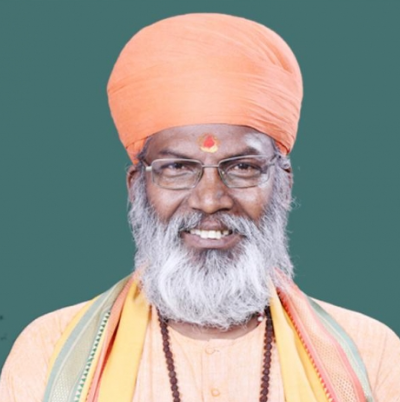
Sakshi Maharaj is one of Uttar Pradesh’s most enduring saffron politicians who reinvented his electoral geography from Mathura to Farrukhabad and finally to Unnao over three decades. Born Sachchidanand Hari Sakshi on 12 January 1956 at Sakshi Dham in Kasganj/Etah district, he belongs to the Lodh OBC community and is considered its tallest national face after late Kalyan Singh. His career began as a sadhu claiming Acharya Mahamandleshwar of Nirmal Panchayati Akhada, then evolved into a shrewd caste strategist. Associated with BJP since the Ram Mandir movement, briefly with Samajwadi Party, he returned to BJP in 2014 and secured three consecutive wins in Unnao. Known for controversial remarks, educational empire, and his slogan ‘Dhai lakh Lodhi, baaki sab Modi’, he blends Hindutva with Lodh arithmetic.
Sakshi Maharaj was born on 12 January 1956 at Sakshi Dham, Bilaspur village in Kasganj, then part of Etah district, Uttar Pradesh, into a Lodh OBC family. His parents are recorded as Atmanandji Maharaj Premi and Madalasa Devi Lodhi. The environment was deeply religious, pulling him toward ashram life from childhood.
He completed early schooling locally before pursuing Sanskrit education, earning Shastri and Acharya titles and later claiming a PhD. His mastery of religious discourse gave him a platform as a kathavachak by his early twenties.
In Haridwar he associated with Shri Nirmal Panchayati Akhada, one of the oldest monastic orders, and projected himself as Acharya Mahamandleshwar, a status equated by his followers to Jagadguru Shankaracharya. That claim brought him devotees across western UP.
The Lodh community, classified as OBC, is demographically powerful in Bundelkhand, Rohilkhand and central UP. Sakshi positioned himself as its political voice after Kalyan Singh, leveraging caste solidarity for electoral utility.
Although his marital status has been debated in affidavits and courts, publicly he lives as a monk. His extended family manages educational trusts. Brothers and nephews look after Sakshi Maharaj Public Trust institutions.
Starting in the early 1990s he built a network of ashrams and schools – inter colleges, degree colleges and management institutes under Sakshi Maharaj Group. These institutions created both income and patronage.
During the Ram Janmabhoomi movement he became a BJP campaigner, organizing Rath-linked meetings for Lodh clusters. His speeches mixed mythology and backward caste pride, giving him recall beyond religious circles.
Kalyan Singh’s rise as Chief Minister in 1991 helped Sakshi get a Lok Sabha ticket from Mathura. Kalyan’s Lodh base needed a religious face and Sakshi fit the role perfectly.
In personal style he prefers saffron robes, distinct headgear and heavy rhetoric. Adversaries describe him as a blend of muscleman and mahant, while supporters call him a social protector of Lodhs.
After 2000 he shifted focus to the Ganga belt – Unnao, Farrukhabad, Hardoi – opening ashrams along the riverine villages where Lodhs, Nishads coexist. That grassroots presence ensured his 2014 transition to Unnao appeared less alien.
Political Career
Political career began in 1991 Lok Sabha from Mathura – first major contest. On BJP ticket Sakshi Maharaj secured 43.2% vote share, winning by about 1.10 lakh votes over Congress. Turnout was 55.1%. Ram wave and Kalyan Singh’s Lodh backing delivered victory.
In 1996 he contested Mathura again – second election. Vote share dropped to 38.9%, margin shrank to 67,452. Despite SP-BSP polarization, BJP symbol saved him. Turnout was 58.3%.
Third win came in 1998 after shift to Farrukhabad. He polled 4,12,890 votes, 44.5% share, margin 98,210, turnout 61.2%. He exploited Lodh vs Yadav dynamic during peak Vajpayee popularity.
Fourth election 1999 Farrukhabad – defeat. SP’s Chandrabhushan Singh won with 48.1%, Sakshi limited to 39.4%, losing by 84,332. Local Brahmin anger overrode Kargil factor.
Between 2004-2009 he switched to Samajwadi Party, remained electorally inactive for Lok Sabha, fought legal battles over criminal cases including alleged involvement in Brahm Dutt Dwivedi murder case where he was later acquitted/discharged.
Comeback fifth big election 2014 from Unnao on BJP return – landslide. ECI data: 5,18,834 votes, 43.18% share, margin 3,10,173 (25.81%) over SP’s Arun Shankar Shukla (2,08,661, 17.37%). Turnout 56.15%.
Sixth election 2019 Unnao – career best. 7,03,507 votes, 56.87% share, margin 4,00,956 (32.41%). Turnout 56.72%. This was second-highest margin nationally after PM Modi. SP’s Arun Shukla got 3,02,551 (24.46%) and Congress Annu Tandon 1,85,634 (15.01%).
Seventh election 2024 – hat-trick with reduced margin. As per ECI: 6,16,133 votes, 47.31% share, defeated SP’s Annu Tandon by 35,818 votes only, sharp 91% drop in margin versus 2019. Turnout 55.89%. Anti-incumbency and Constitution narrative made contest tight.
For future, his strategy remains anchoring 4.5 lakh Lodh plus 2 lakh Nishad core votes in Unnao belt combined with Hindutva polarization.
In 2014 he called Nathuram Godse a patriot during campaign, prompting BJP to distance itself; he later withdrew statement after EC notice.
In 2015 he made controversial remark about women having four children, linking it to madrasa growth, leading to National Commission for Women notice.
His name surfaced in 1996 Bramha Dutt Dwivedi murder case, long-time allegation of political rivalry; courts eventually relieved him for lack of evidence but stigma persisted.
In 2017 during demonetization debate he delivered inflammatory speech against madrasas, EC registered Model Code of Conduct violation.
In 2019 he visited rape-accused MLA Kuldeep Singh Sengar in Sitapur jail to thank him for support, triggering nationwide outrage in Unnao rape case context.
In 2021 amid Covid second wave he claimed deaths were not due to oxygen shortage but conspiracy to defame government, drawing criticism from families.
In 2023 he commented on Muslim population growth urging introspection inside mosques, minority commission took suo motu cognizance.
In 2024-2025 Sakshi Maharaj remains active as ruling party MP focusing on rail doubling in Unnao, Ganga Expressway link, Trans-Ganga City industrial project. Parliament attendance 68%, participated in 12 debates, asked 34 questions. After narrow 2024 win, he is trying to rebuild connect via Ashram medical camps.
As of 2026 he will turn 70, BJP internal age cap discussion puts his ticket under question, yet he retains proximity to Amit Shah camp for OBC outreach.
Scenario 1 – BJP retains ticket in 2027: If BJP wants to retain Lodhi consolidation ahead of 2027 UP Assembly, it may repeat him in Unnao Lok Sabha or accommodate son in Mohan/Safipur Assembly seat. Probability 45%.
Scenario 2 – Shift to organization: He could be moved to National OBC Morcha or made MLC and given state minister role, saving face while creating space for new Unnao face. Probability 35%.
Scenario 3 – Rebellion pressure: If denied ticket, he may threaten independent mobilization of Lodh Mahasabha, as he did in 2006, forcing bargaining. Probability 20%.
FAQ
Q1. What is Sakshi Maharaj caste and age? A: He belongs to Lodh OBC caste, born 12 Jan 1956, age 70 in 2026. Tallest Lodh leader in BJP after Kalyan Singh.
Q2. How many times has Sakshi Maharaj won Lok Sabha? A: Won 6 times – 1991 Mathura, 1996 Mathura, 1998 Farrukhabad, 2014 Unnao, 2019 Unnao, 2024 Unnao; lost 1999 Farrukhabad.
Q3. What is his vote bank in Unnao? A: Core 4.5 lakh Lodh + 2 lakh Nishad plus BJP Hindutva upper caste votes. His slogan ‘Dhai lakh Lodhi, baaki Modi’ captures it.
Q4. What are major controversies? A: Calling Godse patriot, remarks on women population, madrasa comments, visiting Sengar in jail 2019, Bramha Dutt Dwivedi murder accusation later cleared.
Q5. What next in 2027? A: After margin dropped to 35k in 2024, ticket uncertain. Possibilities: repeat ticket, shift to organizational/MLC minister post, or fielding son in Assembly.