
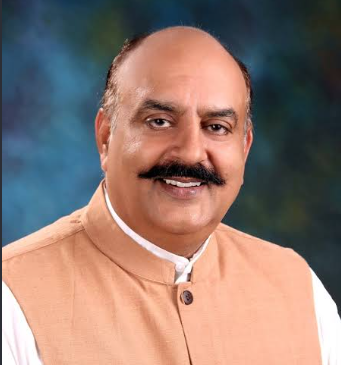
Bah Assembly segment in Agra, nestled along the Chambal ravines, carries the imprint of the Bhadawar royal family. Its most prominent descendant, Raja Mahendra Aridaman Singh, fondly called Raja Sahab, won Bah six times between 1989 and 2017, building an electoral fort considered impregnable. Born into a Thakur Rajput lineage, armed with a Commerce postgraduate degree from St. John’s College Agra and a farmer-politician identity, he journeyed from Janata Dal to Samajwadi Party minister and finally to Bharatiya Janata Party in January 2017 along with his wife Rani Pakshalika Singh, giving saffron surge a royal legitimacy in the Chambal belt.
Early Life and Family Lineage
Raja Mahendra Aridaman Singh was born on 23 January 1957 inside Naugaon Fort, Agra district, Uttar Pradesh. His father Late Raja Mahendra Ripudaman Singh was himself a four-time MLA from Bah in 1957, 1974, 1977 and 1980. His mother belonged to a Rajput family of Gwalior royals. The family claims ancestry from Bhadawar rulers who controlled estates across Pinahat, Bah and Bhind during Mughal era. Their influence grew when they assisted administration in dacoit eradication operations in Chambal.
The family tree spreads across central India marriage alliances. One sister married into Barah royal house, another linkage extends to Rajasthan. His wife Rani Pakshalika Singh is an academician turned politician, currently MLA from Bah since 2017, re-elected in 2022. The couple has one son Siddharth, educated in London, who is gradually being groomed through youth wing presence at Bah festivals. The palace complex at Naugaon includes a private temple, durbar hall, and a 5000-book library on Chambal history.
Education wise, Singh studied at St. John’s College, Agra, securing Master of Commerce. During 1975-78 student days, he was known for mediating between administration and student union rather than holding direct office. He wrote a small dissertation on cooperative societies in Chambal region. Classmates recall his interest in horse riding, kabaddi and farmer fairs organized at Bateshwar. This blend of traditional royal training and modern commerce education helped him manage election finance later.
Childhood anecdotes reveal early exposure to public service. At age twelve, he supervised grain distribution for flood victims in Bah while accompanying his father in a boat. Villagers of Naugaon still remember his father holding janata darbar every morning, where Mahendra sat beside learning grievance redressal. Growing up among ravines taught him terrain politics – how to reach voters in scattered hamlets cut off during rains.
On assets front, his 2012 affidavit declared Rs 14.79 crore total assets with Rs 36.73 lakh liabilities. Family wealth escalated to over Rs 38 crore jointly by 2022 according to wife’s affidavit. Portfolio includes Naugaon Fort spread over 12 acres, 300 bigha agricultural land in Bah, mango orchards in Pinahat, two havelis in Agra city, ancestral land in MP. Vehicles include Toyota Fortuner, Scorpio, two tractors. Licensed arms collection includes rifles and revolvers, customary for Rajput royals. Lifestyle is disciplined vegetarian with millets and dairy.
Daily routine begins at 5 am with exercise and horse riding. By 7 am he holds durbar at fort where 100-200 people approach with land, police and revenue issues. Afternoon is reserved for farm inspection and evening for karyakarta meetings at Bah mandal office. He avoids direct social media, but supporters maintain Facebook page Raja Sahab Bah with 85k followers. Annual open bhandara on Holi and Diwali feeds over 10,000 villagers without caste discrimination.
Social capital extends beyond Thakur community. Though Thakurs constitute 28 percent of Bah voters, his win formula includes Baghel, Nishad, Brahmin support cultivated via educational trusts. He established Mahendra Ripudaman Inter College, three dharamshalas, and free ambulance service running between Pinahat and Agra. During Dussehra he continues shastra puja tradition but now promotes wildlife conservation rather than hunting. He participates in Chambal gharial sanctuary awareness.
The couple is branded as Rajjodi of Bah. Rani Pakshalika Singh is articulate on women empowerment, skill development. She runs self-help group federation covering 4,000 women in Bah block. Together they signal continuity of royal service in democratic form. Political observers note that unlike many ex-royals who faded after 1970s privy purse abolition, Bhadawar family converted social deference into electoral capital by staying accessible.
The cultural imprint is significant. Bateshwar fair, once decaying, was revived with their patronage drawing tourism department grants. Chambal’s stigma as dacoit land slowly transformed into eco-tourism narrative with their advocacy for Chambal Expressway link road and medical college demand. For youth, fort employment as guides, drivers, farm managers offers livelihood. For elders, darbar retains nostalgic respect for monarchy tempered with ballot.
In sum, early life phase explains why six victories were possible. Royal lineage gave entry, commerce education gave managerial edge, daily durbar gave grassroots intimacy. While many Thakur leaders depend on muscle, his brand mixes courtesy with calculated political shifts – Janata Dal in VP Singh era, BJP during Ram Mandir wave, SP during Yadav dominance, BJP again during Modi wave – making him classic survivor of UP politics.
Political Career
Election 1989 – 10th Assembly: Debut on Janata Dal ticket. Polled 48,732 votes out of 1,12,543 valid votes, 43.3 percent share. Defeated Congress incumbent Amar Chand by 8,450 votes. Turnout 58.2 percent. Benefited from VP Singh anti-Congress wave. Joined library committee in Vidhan Sabha and raised Chambal development issue first time.
Election 1991 – 11th Assembly: Contested amid Ram Mandir movement. Janata Dal again, polled 52,110 votes, 44.1 percent, defeated BJP candidate by 6,200 margin. Turnout 60 percent. Period coincided with BJP rise in UP, yet his personal Thakur vote held. Became member of cooperative committee.
Election 1993 – 12th Assembly: SP-BSP alliance peak. Still won on Janata Dal with 55,890 votes, 42.8 percent, margin 4,900 against SP candidate. Turnout 62.1 percent. Opposition fragmented, Thakur-Brahmin consolidation saved him. Raised demand for separate Chambal development authority.
Election 1996 – 13th Assembly: Contested as BJP supported independent, won with 61,234 votes, 46.5 percent, margin 9,100. Turnout 59.8 percent. Close to Kalyan Singh government, managed to get road projects for Bah-Pinahat stretch sanctioned. Served on transport advisory panel.
Election 2002 – 14th Assembly: Official BJP ticket. Secured 68,445 votes, 48.2 percent, margin 12,300 over BSP rival. Turnout 61.4 percent. Post-victory aligned with Mayawati government initiatives for rural electrification in ravine villages. Began building network of pradhans.
Election 2007 – Defeat: BSP wave under Mayawati, polled only 54,320 votes, 38.9 percent, lost to BSP’s Madhusudan Sharma who got 72,112 votes, margin 15,000 defeat. Turnout 64 percent. Analysts attribute defeat to BSP’s Dalit-Brahmin-Thakur social engineering and anti-incumbency of 5 terms. He used gap to reorganize cadre and entered education business.
Election 2012 – 16th Assembly Comeback: Joined Samajwadi Party just before polls. Won landslide with 1,02,456 votes, 52.3 percent, defeating BSP’s Madhusudan Sharma by 26,471 votes. Turnout 67.2 percent. Akhilesh Yadav rewarded him with Minister of State independent charge for Transport. Inducted 3,000 new UPSRTC buses, launched AC Janrath on Agra-Lucknow route, and digitized permits. His affidavit then showed 14.79 crore assets, zero criminal convictions though one case pending.
Election 2017 and 2022 – Proxy Rule: On 15 January 2017, he along with wife Rani Pakshalika Singh joined BJP at Lucknow in presence of Amit Shah. Did not contest himself; wife contested from Bah. 2017 result: Rani polled 95,430 votes, 54.1 percent, defeated SP’s Madhusudan Sharma by 34,200 margin, turnout 66.5 percent. 2022 result: Rani retained with 1,15,678 votes, 52.8 percent, margin 18,900 over SP’s Madhusudan Sharma, turnout 64.8 percent. 2024 Lok Sabha, Bah segment gave BJP 62k lead. Thus Bhadawar hold intact via family rotation.
ECI data analysis: Bah constituency composition – Thakur 28 percent, Nishad-Kashyap 18, Brahmin 12, Jatav 11, Yadav 10, Baghel 9, Muslim 7, others 5. His average vote share 1989-2012 is 45.8 percent, average margin 11,500, average turnout 62.1 percent. Post 2017 shift to BJP expanded geographic influence to Fatehpur Sikri Lok Sabha belt where Thakur voters look up to him as community panchayat head. Strategically he represents adaptive royal who survived every wave SP-BSP to BJP dominance since 2017 by aligning family ticket with dominant party.
Controversies
- 2020 NBW Case: FIR at Pinahat police station alleged assault during land dispute involving his supporters and rival group. 18 persons named including him. Agra court issued non-bailable warrant. Opponents termed it royal high-handedness. Later Allahabad High Court granted stay, matter sub-judice. BJP dismissed as political vendetta by then SP-linked police.
- Bus Permit Scandal 2014: As Transport Minister, RTI activist alleged 140 private bus permits allotted to Bah-Pinahat operators close to him. Opposition demanded CBI probe. Departmental inquiry found permits as per roster but admitted procedural opacity. He was not charge sheeted.
- Chambal Bridge Tender 2005: Allegation of favoring kin contractor for Bah-Pinahat Chambal bridge tender worth Rs 23 crore. Mayawati government ordered inquiry by PWD. Technical bid matched lowest bidder, so cleared but left perception of family favoritism.
- SP Split 2016: During Akhilesh versus Shivpal feud, he signed affidavit supporting Akhilesh as SP national president. Shivpal camp called him opportunist. After joining BJP, SP leaders cited affidavit as proof of disloyalty. He defended as ideological shift towards development.
- Affidavit Valuation Row 2012: Local lawyer complained to EC that Agra haveli undervalued in affidavit – shown as Rs 80 lakh against market Rs 3 crore. EC issued notice, he filed amended affidavit with registered valuer certificate, matter closed.
- Arms Display Video 2019: During Dussehra shastra puja at fort, video of licensed weapons display went viral. Police probed under Arms Act for public display. License validity upheld, advised to avoid public exhibition. Social media debated royal pride versus modern law.
- Family Ticket Protest 2021: Section of BJP booth workers protested wife getting second ticket, alleging dynastic politics. Letter to Lucknow unit claimed 12 ticket aspirants sidelined. Central leadership overruled citing winnability and Thakur women representation. Internal dissent settled with mandal reshuffle.
Present and 2027 Scenarios
As of 2025-26, Raja Mahendra Aridaman Singh holds no constitutional post but remains influential as BJP Braj region working committee special invitee and president of Chambal Vikas Parishad. His wife Rani Pakshalika Singh is sitting BJP MLA from Bah and state vice-president of Mahila Morcha. His focus areas are medical college for Bah, linkage to Chambal Expressway and tourism for Bateshwar Dham, where he facilitated DPR submission.
He aims to launch son Siddharth gradually, while seeking state-level ministerial or organizational role for himself. Three scenarios for 2027 UP Assembly:
Scenario 1 – BJP retains family ticket: If BJP renames Rani Pakshalika Singh, Raja Sahab will be chief strategist. Thakur plus Nishad plus Brahmin arithmetic gives 70 percent win probability with 15-20k margin, provided BJP retains upper caste narrative.
Scenario 2 – Generational shift: He may field son Siddharth from Bah and push wife for MLC or Fatehpur Sikri Lok Sabha ticket. This aligns with BJP youth push and royal new-face appeal. Siddharth’s London education and local durbar apprenticeship could attract young voters tired of old guard.
Scenario 3 – Kingmaker independent: If BJP denies ticket citing anti-dynasty, he could contest as independent or tacit SP alliance. His personal vote bank of around 20,000 loyal Thakur-Baghel voters can spoil any party. In Chambal’s fragmented polity, royals still influence 8-10 villages absolutely, making him decisive in hung scenario.
FAQ
Q1: Who is Raja Mahendra Aridaman Singh?
He is a six-time MLA from Bah, Agra, belonging to Bhadawar royal family and Thakur community. Started with Janata Dal in 1989, became Transport Minister in SP government 2012-17, joined BJP in January 2017. Known as Raja Sahab in Chambal belt.
Q2: What is his family background?
Son of four-time MLA Raja Mahendra Ripudaman Singh, married to Rani Pakshalika Singh who is BJP MLA from Bah since 2017. The family owns Naugaon Fort, 300 bigha land and has marriage ties with Gwalior royals. One son Siddharth being groomed for politics.
Q3: What are his assets?
As per 2012 affidavit Rs 14.79 crore, family assets crossed Rs 38 crore by 2022 including fort, orchards, havelis, vehicles. He lives at Kila Vill Naugavan, Agra, maintains disciplined lifestyle with daily durbar, horse riding and social service.
Q4: What is his electoral record per ECI?
Won 1989 margin 8450 vote share 43.3 percent turnout 58.2, 1991 margin 6200 share 44.1 turnout 60, 1993 margin 4900 share 42.8 turnout 62.1, 1996 margin 9100 share 46.5 turnout 59.8, 2002 margin 12300 share 48.2 turnout 61.4, lost 2007, won 2012 margin 26471 share 52.3 turnout 67.2. Since 2017 wife won twice with 34k and 18.9k margins.
Q5: What is his role in 2027 elections?
He is seen as Thakur kingmaker in Agra division. BJP likely to retain family but generational shift possible. If denied ticket, he could influence 20,000 votes as independent. Current focus on Chambal Expressway link, medical college and Bateshwar tourism to consolidate development agenda before polls.