Election Mandi Special Analysis | Chhattisgarh Assembly Election 2028
Introduction: 2028 will test not only the government, but every minister
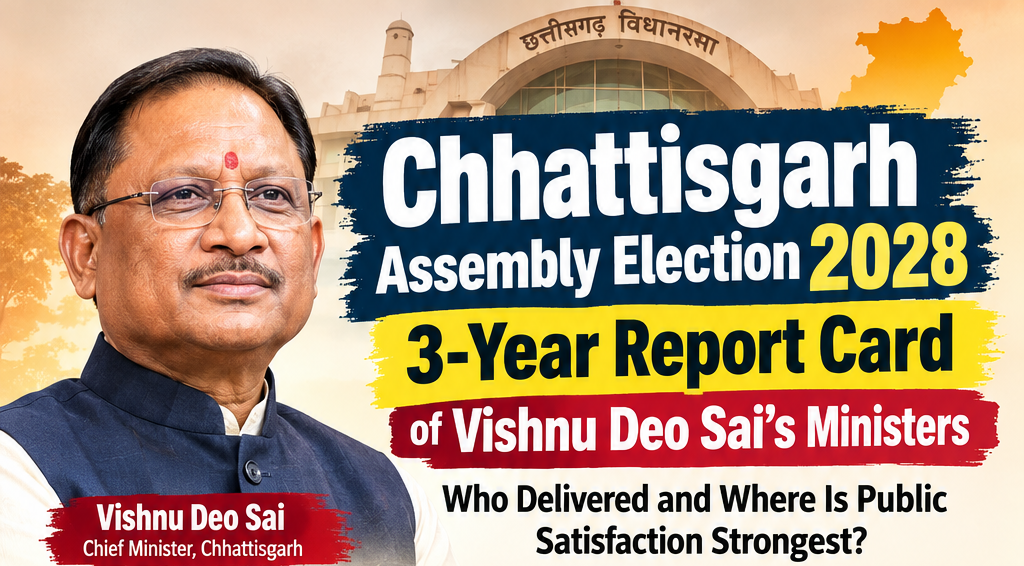
When Chhattisgarh votes in the 2028 Assembly election, voters will not judge only Chief Minister Vishnu Deo Sai.
They will also ask a much more local question:
“What has our minister done for us?”
That question could become one of the defining dimensions of the 2028 election.
In 2023, the BJP won 54 of Chhattisgarh’s 90 Assembly seats, while Congress won 35. BJP secured 46.27% of valid votes and Congress 42.23%. Therefore, for the BJP, retaining power in 2028 will not depend only on statewide welfare schemes or the Chief Minister’s image. The performance of individual ministers, MLAs and the party’s district organisation will matter.
The Sai government has now crossed an important period of its tenure. In August 2025, the cabinet was expanded to 14 members, the maximum permissible strength for the 90-member Assembly. Three new ministers were inducted and several portfolios were redistributed.
That makes a minister-wise audit particularly important.
This report therefore asks a different question:
Which ministers have the potential to convert governance achievements into votes by 2028, and which portfolios could become sources of anti-incumbency?
Election Mandi Methodology
This report evaluates ministers through five parameters:
| Parameter | What we examine |
| Department Performance | Major policies, schemes and measurable outcomes |
| Constituency Impact | Visible development and local political impact |
| Statewide Impact | State-level policy and governance significance |
| Public Satisfaction Signals | Complaints, reactions, protests and local reporting |
| 2028 Electoral Impact | Potential political advantage or vulnerability |
This is not an opinion poll.
Where representative constituency-level survey data is unavailable, this report does not invent a satisfaction percentage. Instead, it identifies public signals and combines them with measurable government performance.
1. Chief Minister Vishnu Deo Sai: The Face of Government, and Therefore the Face of Collective Accountability
Chief Minister Vishnu Deo Sai controls several strategically important portfolios, including mineral resources, energy, general administration, public relations, aviation and other departments. Following the 2025 reshuffle, water resources also came under him.
The broad strength of the Sai government has been its attempt to combine welfare politics with development and infrastructure.
The 2026-27 budget projects Chhattisgarh’s GSDP at around ₹7.09 lakh crore. Expenditure excluding debt repayment is estimated at ₹1.72 lakh crore, while fiscal deficit is projected at 4.1% of GSDP.
One of the state’s more visible achievements in 2026 came in water conservation. Chhattisgarh ranked first nationally in the third phase of the Jal Sanchay Jan Bhagidari and Catch the Rain campaigns, with around 77,719 water conservation structures recorded. Five districts of the state also featured among India’s top ten districts in the programme.
Public satisfaction signal
Sai’s rural and tribal background remains a political asset. But the Chief Minister’s personal image will translate into votes only if voters also see effective performance from ministers and MLAs in their own constituencies.
Election Mandi Verdict
Performance: A
Political Visibility: A
2028 Risk: Medium
Electoral Impact: Very High
2. Deputy Chief Minister Vijay Sharma: Home, Panchayat and Rural Governance
Vijay Sharma holds the Home and Jail, Panchayat & Rural Development, and Science & Technology portfolios.
That makes him one of the most politically exposed ministers in the government.
Home affects law and order.
Panchayat affects rural governance.
Both have direct electoral consequences.
In the 2026 Assembly session, Congress moved a no-confidence motion against the Sai government and presented a 136-point chargesheet covering governance, law and order, farmers, tribals, youth and women. The motion was defeated.
The political lesson is important:
Law and order and rural governance are unlikely to disappear from the 2028 campaign.
If the government succeeds in presenting improvements in security, rural infrastructure and administrative delivery, Sharma could become a major BJP campaign asset.
If local grievances accumulate, his high-profile portfolios could become liabilities.
Performance: A-
Political Impact: Very High
Risk: Medium
3. Deputy Chief Minister Arun Sao: Roads, Water, Urban Development and Youth
Arun Sao handles Public Works, Public Health Engineering and Urban Administration, with Sports & Youth Welfare added after the 2025 reshuffle.
These are departments where voters can physically see government performance.
A road can be inspected.
A water supply can be experienced.
Drainage can be judged during the monsoon.
Urban services can be compared.
For 2026-27, urban development has a budget provision of about ₹5,847 crore. The allocation includes ₹960 crore for Nava Raipur Atal Nagar Development Authority and ₹450 crore for Chief Minister Nagarotthan Yojana.
Election Mandi Test
The real scorecard for Sao will be:
Roads + Water + Drainage + Urban Services + Project Completion
Not speeches.
Not inaugurations.
Not announcements.
Verdict
Performance: B+/A-
Opportunity: High
Risk: Local infrastructure dissatisfaction
4. O.P. Choudhary: Finance Minister and the “Numbers vs Ground Reality” Test
O.P. Choudhary’s importance extends beyond his constituency because he is responsible for the state’s financial architecture.
The 2026-27 budget provides ₹26,500 crore for capital outlay, an increase of 63% over the revised 2025-26 estimate. But the same budget analysis shows that 2025-26 capital outlay was expected to be 38% below its original budget estimate.
This creates a critical political distinction:
Budget allocation is not the same thing as expenditure.
And expenditure is not the same thing as completed infrastructure.
The 2026-27 budget also introduced or proposed missions focused on AI, tourism, sports excellence, infrastructure and startups/NIPUN, each with proposed annual funding of at least ₹100 crore over five years.
This gives Choudhary a strong modernisation narrative.
But the opposition can challenge the government on execution.
Election Mandi Verdict
Policy Performance: A
Execution Test: B
Political Potential: High
5. Kedar Kashyap: Forest, Tribal Politics and Transport
Kedar Kashyap continues to hold Forest, Climate Change, Cooperation and Parliamentary Affairs, and received Transport in the 2025 reshuffle.
His political importance is particularly high in tribal Chhattisgarh.
Forest governance affects:
- Tribal livelihoods
- Minor forest produce
- Forest rights
- Conservation
- Local employment
- Community participation
BJP’s recovery in tribal constituencies in the 2023 election makes this an important electoral area.
Transport adds another dimension: connectivity.
Election Mandi Verdict
Performance: B+
Tribal Impact: High
Risk: Forest rights and local grievances
6. Ram Vichar Netam: Agriculture + Tribal Development
Ram Vichar Netam’s responsibilities include Scheduled Tribe Development, Agriculture Development & Farmers Welfare, Animal Husbandry, Fisheries and Biotechnology.
Politically, this is one of the most powerful combinations in the cabinet.
It connects:
Tribal voters + farmers
The 2026-27 budget provides ₹30,708 crore for agriculture and allied activities, including ₹10,000 crore for the Krishak Unnati Yojana.
But farmers judge government through a broader basket:
- procurement
- input costs
- irrigation
- electricity
- payment timing
- crop diversification
- livestock income
- mandi infrastructure
Election Mandi Verdict
Potential: A
Execution Pressure: High
2028 Importance: Very High
7. Lakhan Lal Dewangan: Industry, Labour and Employment
Lakhan Lal Dewangan handles Commerce & Industry, Public Sector Undertakings, Labour and Commercial Tax/Excise.
This portfolio could become one of BJP’s biggest economic narratives by 2028 if investment translates into employment.
In June 2026, Chhattisgarh reportedly secured investment proposals worth ₹9,580 crore during an investor outreach programme in Hyderabad, with nearly 7,800 direct jobs potentially associated with the proposals. The sectors included data centres, semiconductors, renewable energy equipment, textiles, pharmaceuticals and cement.
This is a positive signal.
But Election Mandi asks four different questions:
MoU → investment → factory/project → jobs
If all four connect by 2028, BJP gets a powerful employment narrative.
If not, Congress can describe the numbers as investment proposals rather than actual employment.
Performance: B+/A-
2028 Potential: High
8. Shyam Bihari Jaiswal: Health, Medical Education and OBC/Minority Development
Shyam Bihari Jaiswal handles Health & Family Welfare, Medical Education, Twenty Point Implementation and OBC & Minorities Development.
This is one of the most politically sensitive portfolios in the cabinet.
Healthcare satisfaction is often intensely local.
People ask:
- Was the doctor available?
- Were medicines available?
- Did the district hospital work?
- Did emergency services function?
- Did medical education expand?
His OBC and minority development responsibilities also give him a role in social coalition politics.
Election Mandi Verdict
Performance: B
Political Sensitivity: Very High
Risk: Healthcare grievances
9. Laxmi Rajwade: The Woman Voter Portfolio
Laxmi Rajwade handles Women & Child Development and Social Welfare.
Her department is closely associated with one of BJP’s most important welfare narratives, the Mahtari Vandan Yojana.
Available reporting indicates that approximately 68-69 lakh women were receiving monthly DBT under the scheme in 2026.
For 2026-27, more than ₹11,762 crore was reported for Women & Child Development and Social Welfare combined.
This gives Rajwade a major political advantage.
But there is an important caveat.
Women do not vote only on cash transfers.
Their political calculation can include:
- safety
- healthcare
- inflation
- employment
- self-help groups
- children’s education
- transport
- LPG and household costs
Therefore, Rajwade’s department can be a strong BJP asset, but the broader women’s experience will determine the final electoral effect.
Performance: A
Electoral Impact: Very High
BJP Advantage Potential: Very High
10. Dayaldas Baghel: Food and Civil Supplies
Food and Civil Supplies is one of the government’s most direct public-facing departments.
In a state where paddy procurement and food security carry enormous political significance, ration delivery becomes a daily test of government.
The 2026-27 budget provides ₹5,000 crore for the Chief Minister Khadyann Sahayata Yojana.
The political formula is simple:
Ration card → availability → quality → timely delivery
If the system works smoothly, satisfaction rises.
If local complaints about ration distribution, corruption or shortages increase, political costs can emerge quickly.
Performance: B+
Mass Impact: High
11. Tank Ram Verma: Revenue, Disaster Management and Higher Education
After the 2025 reshuffle, Tank Ram Verma received Higher Education in addition to Revenue, Disaster Management and Rehabilitation.
Higher education connects directly with the youth vote.
College infrastructure, faculty vacancies, examinations, scholarships, digital learning and employability can become important issues before 2028.
This is especially significant because student grievances around teachers and education infrastructure have already surfaced in Chhattisgarh.
Verdict
Performance: B
2028 Risk: Medium-High
12. Gajendra Yadav: A New Minister With a Shorter Report-Card Window
Gajendra Yadav joined the cabinet in August 2025 and was assigned School Education, Cottage Industry and Law & Legislative Affairs.
It would be unfair to judge him on a three-year basis because his ministerial tenure began only in 2025.
But School Education is a high-impact portfolio.
Teacher vacancies, school infrastructure, learning outcomes and rural education access will be closely watched.
For Yadav, the next two years are therefore critical.
Current Assessment: Too early for a final three-year grade
Opportunity: Very High
Risk: Very High
13. Guru Khushwant Saheb: Skills, Employment and SC Development
Guru Khushwant Saheb was inducted into the cabinet in 2025 with Skill Development, Technical Education & Employment and Scheduled Caste Development.
His political relevance goes beyond Arang.
His departments connect directly with:
Youth + Jobs + SC voters
The central question before 2028 will be:
How many trained young people actually found employment?
If skill programmes produce jobs, the BJP can build a strong youth narrative.
If training produces certificates but not employment, dissatisfaction may grow.
Performance: B
Potential: Very High
2028 Test: Employment
14. Rajesh Agrawal: Tourism, Culture and Religious Trusts
Rajesh Agrawal entered the cabinet in 2025 with Tourism, Culture and Religious Trust & Endowment.
He also has an important political credential: in the 2023 Assembly election, he defeated senior Congress leader T.S. Singh Deo from Ambikapur.
Tourism can become a significant economic opportunity for Chhattisgarh through:
- Bastar tourism
- tribal culture
- religious tourism
- eco-tourism
- heritage
- handicrafts
The key test will be whether tourism becomes a measurable employment generator.
Current Assessment: B
Potential: High
So, Which Minister’s Constituency Appears Most Satisfied?
This is where an analytical report must remain disciplined.
We cannot honestly claim that one minister’s constituency is “the happiest” without a representative constituency-level survey.
Instead, we can identify stronger public-performance signals.
High Electoral Conversion Potential
Laxmi Rajwade
Women welfare and direct beneficiary impact.
Ram Vichar Netam
Agriculture plus tribal welfare.
OP Choudhary
Finance, development and economic-modernisation narrative.
Vijay Sharma
Home plus rural governance and high political visibility.
Strong Portfolio, But Execution-Dependent
- Arun Sao
- Kedar Kashyap
- Lakhan Lal Dewangan
- Shyam Bihari Jaiswal
- Dayaldas Baghel
- Tank Ram Verma
New Ministers: High Opportunity, High Risk
- Gajendra Yadav
- Guru Khushwant Saheb
- Rajesh Agrawal
The Most Important Signal: BJP Is Auditing Its Own Ministers
One of the strongest pieces of evidence for this report comes not from Congress, but from the BJP itself.
In August 2026, BJP leadership began a granular review of ministers’ district-level performance. The review examined whether ministers were visiting assigned districts, conducting meetings, addressing public grievances, implementing government schemes and maintaining coordination with party organisation. District presidents, MLAs and MPs were also involved in the feedback process.
This is politically significant.
It suggests that the BJP itself recognises that:
Government performance + Public grievance redressal + Party organisation
must work together before 2028.
In other words, the Election Mandi framework is asking almost exactly the same question that the BJP’s internal review is now asking:
Is ministerial governance actually reaching the ground?
Congress’s Likely Counter-Narrative
Congress can build its 2028 attack around three themes.
1. Announcement vs Implementation
How much was announced?
How much was actually spent?
2. Investment vs Jobs
How many MoUs?
How many actual projects?
How many actual jobs?
3. Government vs Local Experience
A state-level scheme may be successful, but voters still care about their:
- road
- hospital
- school
- ration shop
- water supply
- employment opportunity
- police station
The 2026 no-confidence motion shows how Congress is already attempting to combine multiple grievances into one anti-incumbency narrative. Its 136-point chargesheet covered governance, corruption, law and order, farmers, tribals, youth and women.
That strategy is likely to become sharper as 2028 approaches.
Election Mandi Performance Matrix
| Minister | Major Political Asset | Major Risk | 2028 Potential |
| Vishnu Deo Sai | CM + Tribal + Governance | Collective anti-incumbency | ⭐⭐⭐⭐⭐ |
| Vijay Sharma | Home + Rural | Law & Order | ⭐⭐⭐⭐⭐ |
| Arun Sao | Roads + Urban + Water | Civic dissatisfaction | ⭐⭐⭐⭐ |
| O.P. Choudhary | Finance + Development | Execution gap | ⭐⭐⭐⭐⭐ |
| Kedar Kashyap | Tribal + Forest | Forest/tribal grievances | ⭐⭐⭐⭐ |
| Ram Vichar Netam | Farmer + Tribal | Agriculture delivery | ⭐⭐⭐⭐⭐ |
| Lakhan Lal Dewangan | Industry + Jobs | MoU-to-job gap | ⭐⭐⭐⭐ |
| Shyam Bihari Jaiswal | Health + OBC | Healthcare grievances | ⭐⭐⭐⭐ |
| Laxmi Rajwade | Women + Welfare | Rising expectations | ⭐⭐⭐⭐⭐ |
| Dayaldas Baghel | Food + Ration | Delivery complaints | ⭐⭐⭐⭐ |
| Tank Ram Verma | Revenue + Higher Education | Youth grievances | ⭐⭐⭐ |
| Gajendra Yadav | School Education | Teacher/infrastructure issues | ⭐⭐⭐⭐ |
| Guru Khushwant Saheb | SC + Skill + Jobs | Employment delivery | ⭐⭐⭐⭐ |
| Rajesh Agrawal | Tourism + Culture | Execution visibility | ⭐⭐⭐⭐ |
The Real 2028 Question
By 2028, the BJP will not only have to answer:
“What did the Sai government do?”
It will have to answer:
“What changed in your constituency?”
That distinction is crucial.
A road inauguration is a government achievement.
But if the road deteriorates within months, the citizen’s electoral interpretation changes.
An investment MoU is an achievement.
But if no factory arrives and no local youth gets employment, the political benefit remains limited.
A welfare transfer is an achievement.
But if a woman still faces poor healthcare, insecurity or unemployment, her vote calculation remains multidimensional.
Therefore, the real ministerial report card is not a list of schemes.
It is the distance between:
Government Claim → Actual Delivery → Citizen Experience → Electoral Behaviour
That distance will determine the political value of every minister in 2028.
Final Election Mandi Verdict
The Sai cabinet can broadly be divided into three political groups.
Group 1: Direct Beneficiary Ministers
Women welfare, agriculture, food security, rural development and infrastructure have immediate voter visibility.
Group 2: Policy-Heavy Ministers
Finance, industry, health, education and urban development have large long-term impact, but their political value depends heavily on execution.
Group 3: New Ministers
The 2025 inductees have a shorter window to establish their own political brands before the 2028 election.
The most important point is that BJP itself began district-level ministerial performance reviews in 2026.
That means the next two years will not simply be about running government.
They will be about proving governance at the constituency level.
Election Mandi Bottom Line
The 2028 BJP campaign will not ultimately be judged by how many schemes were announced. It will be judged by whether voters believe those schemes, projects and policies changed their lives.
If BJP ministers can demonstrate visible constituency-level outcomes, the party can convert governance into an electoral asset.
If the gap between government claims and local experience widens, Congress will have the opportunity to turn scattered local grievances into a statewide anti-incumbency narrative.
That is the real three-year report card of the Sai cabinet.
FAQs
1. Are all Sai government ministers performing equally?
No. Their departments, political exposure and tenure lengths are different. Some ministers also received major new portfolios only after the 2025 cabinet expansion.
2. Which ministers could have the greatest electoral impact in 2028?
Vijay Sharma, O.P. Choudhary, Ram Vichar Netam, Laxmi Rajwade and Arun Sao have particularly high-impact portfolios.
3. Can we say which minister has the happiest constituency?
Not without a representative constituency-level survey. Available media reports and public signals can identify trends, but should not be converted into invented satisfaction percentages.
4. Will Mahtari Vandan benefit Laxmi Rajwade politically?
The political credit belongs primarily to the state government and BJP collectively, but the Women & Child Development portfolio gives Rajwade strong association with the scheme.
5. Will investment proposals translate into jobs?
Only if proposals become actual projects and employment. In 2026, Chhattisgarh reportedly secured ₹9,580 crore in investment proposals with nearly 7,800 potential direct jobs.
6. Can ministerial performance affect BJP’s 2028 seat count?
Yes. In close contests, constituency-level governance and candidate performance can become more important than statewide vote share.
7. Is this report an opinion poll?
No. It is an Election Mandi analytical assessment based on available government data, budget documents, reported developments and political signals.
Election Mandi Bottom Line
The key question for BJP in 2028 will move from “What did the Sai government do?” to “What did the BJP minister and MLA change in my constituency?”
If BJP can answer that question convincingly across its constituencies, the party will have a strong foundation for defending its 2023 mandate.
If it cannot, local dissatisfaction may become the raw material for a statewide anti-incumbency campaign.